Human Rights Initiatives
Basic Approach
The parking and mobility services operated by the PARK24 GROUP are supported by a diverse range of stakeholders.
These include members and customers who use our services; property owners and local communities who provide the land and buildings that form the foundation of our business; employees of the Group as well as contractors and business partners engaged in planning, operating, and managing our services, including maintenance, inspection, cleaning, cash collection, roadside assistance, and emergency response; and suppliers who support our operations through the provision of vehicles, equipment, systems, and materials. All of these parties are essential stakeholders for the Group.
The Group recognizes each and every one of these stakeholders as rights holders and places respect for and protection of their human rights at the core of its corporate activities.
Human Rights Policy
The PARK24 GROUP (the “Group”) has established the Group Human Rights Policy (the “Policy”) and has been pursuing initiatives for respecting the human rights of all stakeholders in accordance with the United Nations Guiding Principles on Business and Human Rights (UNGP) and other international standards. The Policy was approved by the Board of Directors of PARK24 CO., LTD. (the “Company”) and applies to all employees of the Group. We will work continuously to obtain the endorsement of the Policy by our suppliers and other business partners and to involve them closely in our efforts to promote respect for human rights.
Promotion Structure
Human rights initiatives are promoted through activities in corporation with the Sustainability Committee and the relevant divisions of Group companies.
Specific initiatives to identify human rights risks that may adversely affect employees of Group companies and measures to counter such risks are carried out mainly by the human resources division in cooperation with the Sustainability Committee as appropriate.
Identification of, and measures against, human rights risks in supply chains are promoted by the Sustainability Committee.
New issues that may emerge in the future will be dealt with the through joint efforts of the Sustainability Committee, the human resources division, the legal & intellectual property division and other relevant divisions.
The above initiatives are reported to and approved by the Company’s Board of Directors as needed.
Initiatives to prevent human rights abuse(Human Rights Due Diligence)
The Group implements the following human rights due diligence* processes in order to respect human rights of persons who are impacted by the Group’s business activities. The implementation of human rights due diligence is proceeding in accordance with the UNGP and the National Action Plan on Business and Human Rights established by the Ministry of Justice.
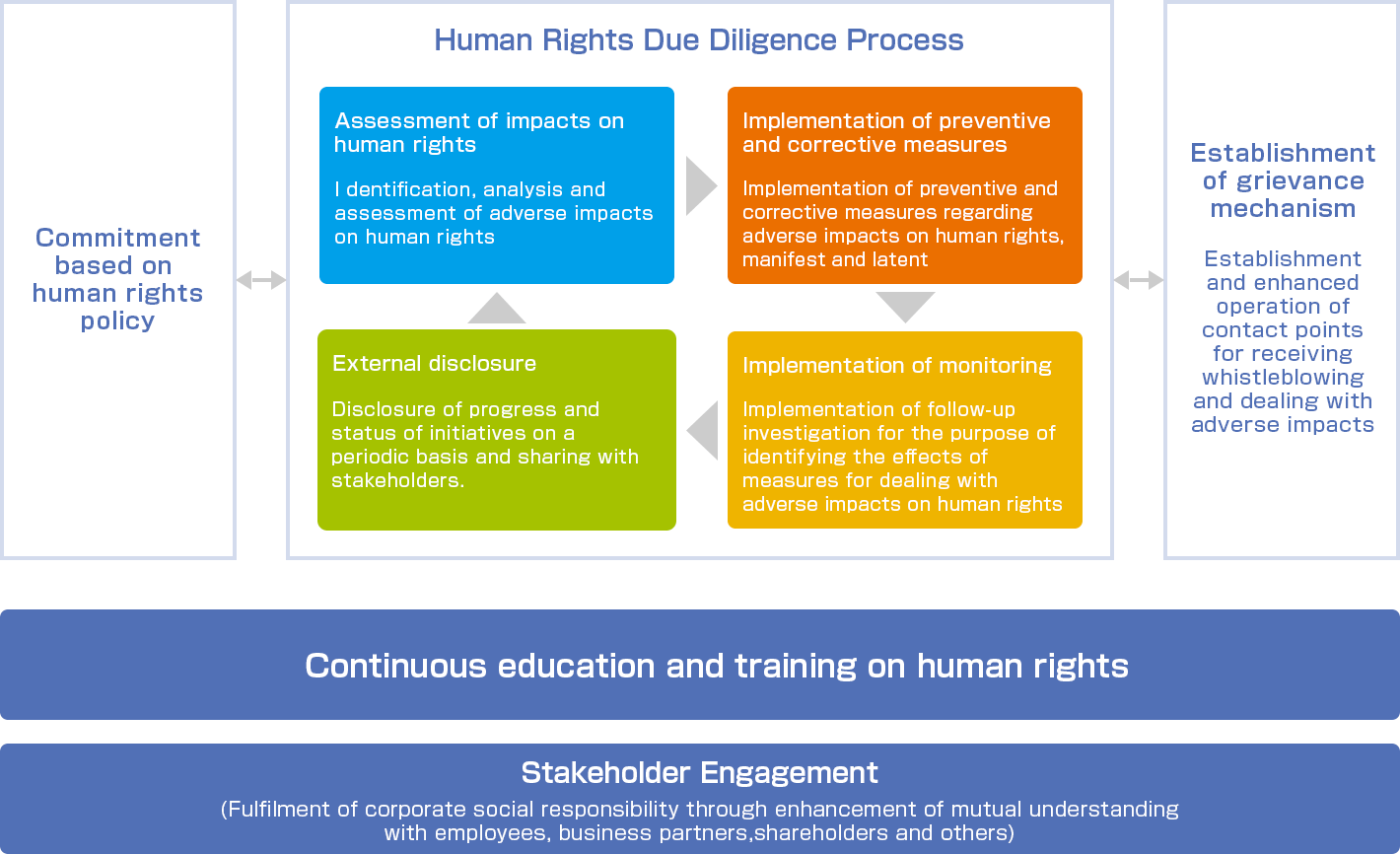
* Human rights due diligence is a way for enterprises to avoid adverse human rights impacts and to relieve victims of human rights abuses.
Assessing human rights impacts
Regarding human rights risks, the Group has identified 26 areas that businesses are expected to respect, based on the “National Action Plan on Business and Human Rights” and related guidelines. The Group conducts analyses and evaluations of potential human rights risks that may arise in the course of its business operations, assessing each risk in terms of its severity and likelihood of occurrence. These assessments cover employees of domestic group companies in Japan, who account for more than 70% of the Group’s total workforce, as well as customers and consumers who use the Group’s services.
The results of these assessments for FY2024 were approved by the Company’s Board of Directors, and all identified human rights risks were assessed as low. At the same time, preventive measures are being developed and implemented in collaboration with relevant departments, particularly for risks that, while assessed as low, may have a higher likelihood of occurrence.
The Group conducts regular reviews of its human rights risk assessments and strives for continuous improvement.
With regard to human rights due diligence at overseas group companies, the PARK24 GROUP plans to commence related initiatives from FY2026 and to gradually expand both the scope and methodologies going forward.
Implementation of preventive and corrective measures and monitoring
It has been confirmed that the Group companies in Japan are taking preventive and corrective measures through the development of rules in accordance with the Japanese laws and regulations and the operation of consultation counters established internally and externally. The internal systems and preventive and corrective measures will be reviewed and reassessed periodically, in order to prevent and mitigate adverse impacts.
Access to remedies
Group companies have established grievance mechanisms, including internal and external compliance consulting counters with dedicated telephone numbers, and consultation service counters, called Good Conditioning Lounges, for persons seeking consultation. These mechanisms ensure that employees can feel safe and free to ask for advice and improve their health and increase their motivation. When a consultation is received, the division in charge conducts an investigation, examines remedies as necessary, and requests relevant divisions to implement corrective measures. The privacy of whistleblowers is fully protected, and any retaliatory action against and disadvantage treatment of whistleblowers is prohibited and not tolerated.
Further, periodic questionnaires are conducted in order to confirm ready access to remedies.
We will continue to implement human rights due diligence, aiming to reduce human rights risks and will work to develop and improve access to remedies as needed.
Human rights education
- The Group strives to achieve thorough understanding, among its employees, of the Group Human Rights Policy. Moreover, in the Group Code of Conduct, respect for human rights is clearly stated, along with statements covering a ban on discrimination, prohibition of child labor and forced labor, respecting diversity and ethical conduct.
- Every year, all employees in Japan are obliged to take compliance confirmation tests for the purpose of ensuring compliance awareness. Moreover, a compliance awareness questionnaire is implemented on a biennial basis. The results of the questionnaire are reported to the management team, and feedback is provided to workplaces, in order to maintain and reinforce the compliance system.
- Information is regularly disseminated to all employees via the company intranet to ensure that correct knowledge on respect for human rights is more widely disseminated within the Group.
- Since FY2021, the Group has strengthened the dissemination of human rights-related information with the aim of promoting understanding and awareness of diversity, equity and inclusion (DEI), including LGBTQ-related issues. From FY2022, the Group has provided human rights training for managers at domestic group companies, covering topics such as DEI, harassment, and discrimination. In FY2023, as part of its ongoing human rights education efforts, the Group newly introduced video-based training programmes for all employees. In FY2024, the Group further enhanced its initiatives by newly conducting harassment prevention training for executive officers and department heads, delivered by external experts such as lawyers and occupational physicians, with the aim of deepening understanding of actions that may lead to human rights violations and improving the ability to respond appropriately. In FY2025, in order to further promote the understanding of human rights, the Group implemented video-based training for managers that incorporates perspectives of the Sustainable Development Goals (SDGs) and focuses on international human rights issues. In addition, the Group expanded its labor and employment training for managers to strengthen educational content and support management-level employees in fostering workplace operations that are grounded in respect for human rights.
Initiatives involving business partners
We ask our major suppliers to conduct a self-check through a questionnaire based on the PARK24 Group Procurement Guidelines to assess the human rights risks in our supply chain.
CSR Procurement Questionnaire (SAQ) for suppliers
Initiatives at overseas Group companies
- The Group Code of Conduct is applied to overseas Group companies in the same manner as to Group companies in Japan, in order to encourage appropriate action for ensuring respect for human rights.
- SECURE PARKING (SP), a Group company located in Australia, has published a statement on the website managed by the Australian government for registering modern slavery statements in accordance with provisions of the Modern Slavery Act 2018 of Australia. In the same manner as in the U.K., the statement is reviewed annually by relevant divisions and approved by SP’s board of directors. The purpose of the statement is to disclose initiatives for identifying, preventing, and mitigating slave labor and human trafficking risks in SP and its supply chain.
The Australian Government’s Online Register for Modern Slavery Statements
- SP is promoting initiatives for diversity and inclusion and published the details of the initiatives on its corporate website.
- Other overseas Group companies have also established internal whistleblowing mechanisms in the countries in which they operate.